.jpg "Software Localization Services: Speak the Language of Your Users")
Software Localization Services: Speak the Language of Your Users
Admit it, your software is not really global until the users feel like it was designed for them. That is the context where software “localization” comes into play. Localization is unlike any other process, enhancement, and requires turning a universal product into something more approachable (and impressive) for all regions you set your targets at.
No matter if you are operating a SaaS platform, mobile app, or even an enterprise system, a professional software localization service ensures your users always feel like the software is at their home, which is everywhere. Localization is not only customizing translation, but also making everything flawless and intuitive.
What Is Software Localization?
Software localization makes sure none of the customers are left out; it is an all-encompassing process of adjusting compromises for tailor-made software customizable interface, and programmed in the specific requesting language or dialect.
Efficient software localization is more than simple translation of text; it is an application for cultural and contextual awareness. An example could be how an expression that is well understood in the U.S. may be misunderstood or be offensive in another country such as Japan or the Middle East. Colors, icons and symbols also could mean something different in other regions. Localization ensures that every little piece of the interface falls in line with user expectations - creating a seamlessly good and respectful user experience in each market.
Another aspect to consider is the technical adaptability of the software you're employing. Consider localized applications - it's vitally important that these applications are designed with support for multilingual content, or at least character sets like Cyrillic, Arabic, or Chinese. Not to mention, keeping functionality in mind, which means maintaining the integrity of the correct date, time, and numeric formats. Without these considerations, even well-translated content may break layouts or muddle user expectations considering many enterprise systems are complex systems and complex systems within compliance-driven industries are even more timely.
These can be:
- Text in the UI involves menus, buttons, and notifications.
- Cultural references that help the system resonate with the user.
- Visual layouts that support different text directions or longer phrases.
- Terms relevant to servicing policy in a region that fully complies with local law.
- Integrating currency and format on real phrases commonly used in speeches.
Staying on brand (or not changing it) is where the localization magic resides as it enables a user’s intent to make localization focus on tone and shapes, contextual relevance still remains intact, but different way.
The Importance of Software Localization
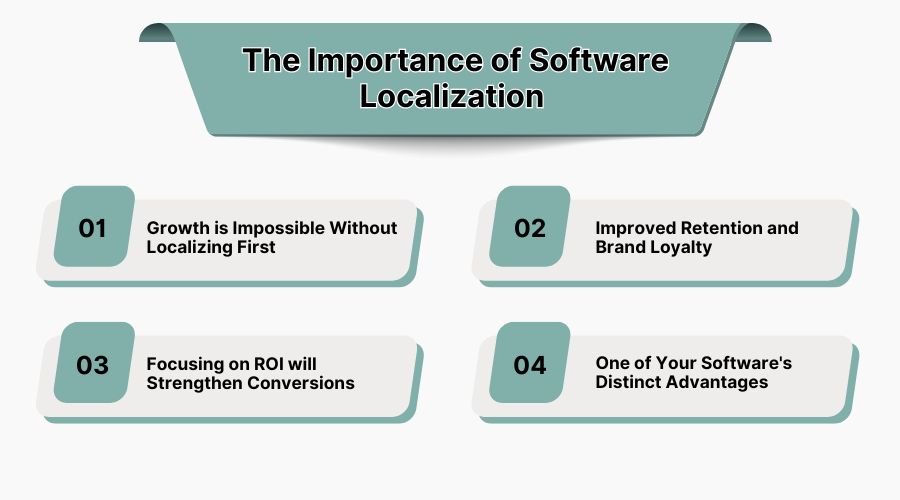
1. Growth is Impossible Without Localizing First
Most software companies seem to hit a roadblock when trying to scale without localization. Sure, English works in some select markets, but there are many others where the language poses a barrier. Once you localize your software, you are quite literally removing “friction” and unlocking new markets.
2. Improved Retention and Brand Loyalty
There's a reason products “understand” their users, the user is more likely to stick around. Having a native language experience is not only comfortable, but it also establishes trust. As a result, you have better retention and onboarding, along with a slew of new advocates who feel they have been understood.
3. Focusing on ROI will Strengthen Conversions
When taking into account the clarifying services offered to a new audience through localization, promotional efforts become more impactful, resulting in increased ROI. Localized calls to action also make sense and assist with onboarding. As a result, in-app purchases increase. It's not solely intended for reaching a new audience, it’s ensuring that they end up converting to paying customers.
4. One of Your Software's Distinct Advantages
All of your competitors may offer such services but do they provide them in the user's preferred language? Addresses like these are what proper localization aims to solve, proving to be advantageous for brands standing out in oversaturated markets.
The Rapid Translate Process of Localization
As a multilingual software house, we aim to make localization effortless and easy to scale. We pair human linguistic skills with automated systems that ensure timelines and standards are always met.
1. Complete Analysis
The first thing we do is analyze the scope, framework, and elements of your software. This includes how your data is stored (e.g., string files, JSON, XML) and how your application functions at the user level.
We do local aware copy evaluations in advance, for example, poorly structured text like hard-coded text or copy that changes – these are serious localization layout issues, which we provide guidance for.
2. Localization Strategy: Translation and Adaptation Strategy
The project is assigned to speakers of the language who are experts in software interface design. It is one thing to speak a language and another to understand the user and technical languages.
Every copy element is translated, adapted, and verified to make sure your brand continues to sound as it is and that cultural expectations are met. Moreover, a Project Manager is assigned to ensure that communication and tracking of milestones are seamless.
3. To Ensure Functional Testing, the Software Does Not Contain Grammatical Relocalization Remakes
We do linguistic and functional testing of the presented software before delivery. The localization includes:
- Contextual review: Clear translation(s) investigation in the user interface.
- Layout checks (design still functional?).
- Usability testing (is logic retained in all iterations and languages?).
- Hunting for bugs (in no scenario should text mark disappear or layout damage).
We will continue iterating until everything is perfect because in new markets, “almost ok” is simply unacceptable.
Localization for Dynamic Content and CI/CD Integration
Modern software is rarely static. Features are rolled out weekly, content updates happen frequently, and product teams often operate in continuous integration/continuous delivery (CI/CD) environments. In this fast-paced cycle, localization can’t be treated as a one-time project; it needs to be an integrated part of your development workflow.
To stay in sync with agile content, we offer real-time sync with your source repos and automated localization pipelines, meaning UI strings, help, feature text any new pieces of content can get flagged for translation the instant they're added to your organization. Whether you're using GitHub, GitLab, or other source code management services or frameworks, our workflows can quickly get integrated into your stack.
We also ensure all strings deliver adequate version-control version checks during each sprint, enabling development and localization teams to work together efficiently. This significantly shortens the time to market for international launches and prevents last-minute fire drills the day before launch.
Localization isn’t just a post-production activity anymore; it’s an agile, embedded part of modern product development.
Localization Possibilities
When it comes to providing our software localization services, we guarantee that we do more than just scratch the surface.We offer many services such as:
- User Interface (UI) Text: Menus, Buttons, Alerts, and Pop-Ups
- Help Sections: Bring confidence to users from the very first day with the Help Sections and Onboarding Guides.
- Technical Documentation: For Power users and internal teams
- Design Specs: Enhance collaboration across all global development teams.
- Website Copy and App Store Listings: Ensure that your product pitches align with your product.
If you have something that is customized and focuses on interactions with users, we ensure that it can be localized.
What Are The Benefits Of a Professional Localization Service?
Of course, translation devices are available, but for someone who is serious about growth, precision, copy-pasting, and accuracy will not suffice. Professional services will ensure the following real-world objectives:
- Critical Accuracy and Precision: Context misses, broken UI, and all awkward phrasing are avoided.
- Cultural Nuance: Tone, humor, and idioms are all captured perfectly.
- Brand Standstill: Every voice that permeates each language matters, so it will remain bold.
- Quicker Entry in Market: Eliminate all detail worries and check every vetted detail, and launch with confidence.
- Privacy and Security: Content, together with your code, is Ksafe in our hands.
Locally and worldwide, Rapid Translate has built its trust because we not only handle software localization, we ensure localized success.
To Sum Up
In the context of today’s economy, your software simply cannot feel foreign in any sense as it competes. Customers today expect a blend of smooth and intuitive interaction with deep cultural appreciation and awareness. And, they'll remember it when you do offer such value.
Adapting to local markets is a strategic cost, no doubt. However, this endeavor pays off tremendously in loyal users, increased market share, and rapid growth around the globe. The software is good enough as it is. Now, it is high time to strategically tailor it for international scalability.
Engaging localization from the outset enables companies to reduce friction with users while also saving time and money, while maintaining consistency across platforms and updates when products evolve. Remember, if a company approaches user experience localization proactively, they eliminate retrofitting costs upon product launch into different languages and cultures. Instead, they can embrace scaling into multilingual markets with confidence.
Additionally, localized software builds an overall sense of engagement and ownership with users. The more users see their regional language, currency, cultural cues, and interface expectations in the app, the more comfortable they feel solving their problems with the product, which strengthens their loyalty as customers. It is beyond just translating text, as it translates the user's entire journey.
In conclusion, localized software experience structure is not just an option to tick off the list; it is a sustainable growth strategy. Existing businesses that acknowledge and invest in it, not only give themselves opportunities to market share in new territories, but they are also deepening the relationship with their customers in a meaningful way. This is especially true in a hyper-connected digital world; that is how thriving businesses set themselves apart!


