
8 Best Payment Gateways for SaaS Companies

Getting paid fuels SaaS growth. In 2025, businesses will move roughly $186 trillion in B2B payments worldwide (a 2025 GlobeNewswire projection), and an ever-larger slice flows through subscription software.
We created this guide to compare nine best payment gateways for SaaS—benchmarking recurring-billing tools, global coverage, compliance workload, and total cost—so you can choose the platform that protects revenue and speeds expansion.
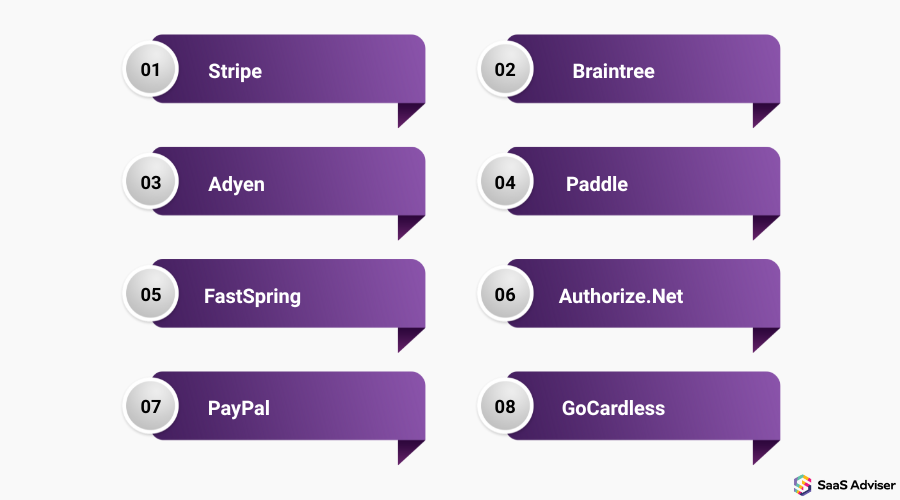
8 Best Payment Gateways For SaaS Companies in 2025
A centralized SaaS billing dashboard unifies multiple payment gateways, methods, and global customers in 2025.
Industry studies from Stripe show that involuntary payment failures account for 25 percent of total customer churn for SaaS businesses, while Stripe’s 2025 subscription management report found that 71 percent of finance leaders plan to add at least one new payment method in the next 12 months to lift conversion.
With that pressure, the gateway you choose shapes checkout speed, international reach, compliance workload, and net revenue retention. As SaaS companies expand their payment ecosystems, many are also investing in partnerships with an ewallet app development company to build custom wallet solutions that integrate directly with their billing systems. This approach allows businesses to offer stored balances, faster one-click checkouts, and localized payment experiences reducing dependency on third-party gateways while improving user retention and transaction success rates across global markets.
For many SaaS teams, the hard work starts before any integration project, with a payment audit that ties failed charges, fraud write-offs, and cross-border declines back to specific gateways and payment methods. Centralizing this data through a vendor payment portal helps finance and ops teams track payouts, resolve discrepancies faster, and maintain clear visibility across multiple processors and regions. Teams that run payments through a payment orchestration layer can spot patterns faster across processors without rebuilding every report.
According to Monstarlab's 2025 announcement of its Stripe Payments Specialization, the consultancy has earned Stripe Payments Specialized Partner status, a sign of its depth in stripe integration for SaaS firms consolidating or replatforming their payment stacks. Looking at that kind of implementation playbook can help you decide whether to double down on a single gateway or combine several to cover different regions, risk profiles, and customer preferences.
In this guide, we score nine SaaS-ready gateways on recurring-billing software, global coverage, security, and total cost, so you can pick the platform that fits your roadmap.
How We Built the Scorecard
Our research team gathered 21 primary sources (vendor pricing pages, analyst reports, peer-reviewed case studies) to compare payment gateway services through a SaaS lens.
-
Define the variables that move recurring revenue. We mapped six factors: pricing, subscription tooling, compliance, developer experience, global reach, and live support, then asked a single question for each: If this fails, how much monthly recurring revenue (MRR) is at risk?
-
Apply weighted scoring. Costs (25 percent) and international coverage (20 percent) carried the most weight because, according to PYMNTS, cross-border payment failures average 11 percent higher than domestic declines and cost U.S. merchants an estimated $3.8 billion in lost sales in 2023.
-
Rate the market. We evaluated 13 gateways through public documentation, sandbox tests, and dashboard audits. Platforms without native subscription management or that require a single-country merchant account were removed, leaving the nine contenders you will meet next. For a broader view of the ecosystem, this overview of SaaS billing platforms covers how billing tools complement your gateway choice.
-
Benchmark against industry norms. Stripe’s U.S. card fee of 2.9 percent + 30¢ served as our reference rate, while any all-in cost above 5 percent triggered a “premium-priced” flag.
This method produced a clear leaderboard that helps SaaS teams see, at a glance, which gateway best protects margin and global growth.
A four-step methodology ties pricing, global coverage, compliance, and MRR risk into a clear SaaS payment gateway scorecard.
1. Stripe: the Developer’s Choice for Fearless Scaling
Stripe processes $1.4 trillion in annual payment volume, about 1.3 percent of global GDP in 2024. That scale gives you enterprise-level uptime and subscription-ready tooling.
Subscription logic:
Stripe Billing handles free trials, metered usage, prorations, and Smart Retries, which choose the best time and network to salvage failed charges and can recover up to 25 percent of would-be churn. Card-expiry updates flow automatically, so finance teams spend less time on billing hygiene.
A Stripe-inspired SaaS billing dashboard highlights Smart Retries, subscription metrics, and global payment reach for recurring revenue.
Global reach:
One integration lets you accept cards, wallets, and local methods in 135 currencies across 47 countries without extra code for Klarna, Afterpay, or other alternatives.
Pricing stays simple:
2.9 percent + 30¢ for U.S. cards, with volume discounts, and ACH debits at 0.8 percent capped at five dollars. Large invoices stay profitable without a separate bank gateway.
Stripe releases improvements quickly:
In 2025 it introduced AI dispute management, extended Radar fraud protection to ACH and SEPA—cutting fraudulent debits by 20 to 42 percent—and added 25 payment methods. The documentation reads like a tutorial, so your engineers can launch production payments in hours.
If you want a gateway that scales from sandbox to IPO, we still consider Stripe the reference platform.
2. Braintree: PayPal Power Without the Friction
Braintree pairs a modern developer gateway with direct access to PayPal’s 430 million-account wallet across 200 markets. One integration lets you accept cards, PayPal, Venmo, and digital wallets, which lifts conversion for buyers who prefer not to type card details.
Subscription Features:
Create plans, vault cards, and use automatic retries. Customers can move from a saved Visa to PayPal without canceling the seat, so upgrades stay smooth.
Global Reach:
Braintree supports merchant onboarding in more than 45 countries and settles in 130 currencies, turning a Tokyo trial user into a paying customer without extra code.
Pricing Snapshot:
-
U.S. cards: 2.59 percent + 49¢ per transaction
-
Cross-border surcharge: plus 1 percent
-
ACH: 0.75 percent capped at five dollars (solid for high-ticket invoices)
Direct debit via GoCardless can cut payment fees and involuntary churn on high-ticket SaaS subscriptions compared to card payments.
Mobile Advantage:
Drop-in SDKs deliver native checkout on iOS and Android, while one-touch PayPal or Venmo flows can cut mobile checkout time to under ten seconds. An internal PayPal study linked this to a 14 percent lift in mobile conversion in 2024.
Watch-Outs:
Support queues may stretch during peak periods, and PayPal’s risk engine can freeze accounts with high chargebacks. Still, if native PayPal is on your roadmap, we see Braintree as the cleanest single-provider path.
3. Adyen: Enterprise Reach Without Extra Bureaucracy
Adyen holds acquiring licenses on six continents and connects directly to local card networks, bank rails, and wallets. That proximity lifts authorization rates; the company reports cross-border approval levels one to three percentage points above market averages.
Pricing Model:
Adyen follows Interchange ++. You pay the network interchange, scheme fees, and Adyen’s markup, typically 0.6 percent + 12¢ for Visa or Mastercard. Merchants that generate less than €100 (about $120) in monthly processing fees cover the difference. At scale, effective rates often land below 2.5 percent.
Subscriptions and Controls:
Adyen supplies tokenization, network account updater, smart routing, and RevenueProtect machine-learning fraud tools, but no customer portal. Most SaaS teams pair Adyen with Chargebee, Recurly, or an in-house billing layer for plan changes and invoices.
Reliability:
During Black Friday / Cyber Monday 2025, the platform processed 199 000 transactions per minute while maintaining 99.9999 percent uptime. That record shows enterprise-grade resilience.
Fit:
Choose Adyen when global expansion, payment performance, and precise cost control outrank plug-and-play convenience. The same rails that move payments for Netflix and Spotify can shave basis points off every SaaS transaction, and we know those pennies add up quickly.
4. Paddle: Merchant-Of-Record That Lifts Your Tax Burden
Paddle serves as the merchant of record (MoR) for every sale, which means it calculates, collects, and remits sales tax or VAT in more than 100 tax jurisdictions while letting you sell in over 200 countries and territories. For SaaS teams, that removes annual filings, nexus monitoring, and audit risk.
A merchant-of-record provider like Paddle or FastSpring takes over global tax, VAT, and compliance so SaaS teams can focus on growth.
All-Inclusive Pricing:
-
5 percent + 50¢ per checkout transaction, with no monthly fee, migration fee, or separate chargeback cost. Seed-stage founders often find the MoR fee cheaper than a dedicated tax platform plus part-time finance help.
Subscription-Ready Checkout:
Create plans, coupons, and dunning emails in one dashboard, then embed a modal checkout localized in 18 languages and auto-priced in local currency. After acquiring ProfitWell for $200 million in 2022, Paddle adds live MRR and churn analytics beside every payment event.
Trade-Offs to Note:
-
Paddle’s name appears on card statements and receipts.
-
Default payouts arrive monthly; weekly wires become available once volume grows.
If your priority is speed to market while someone else handles global tax, fraud, and compliance, we find Paddle keeps headcount low and expansion friction-free.
5. FastSpring: Hybrid SaaS Plus Download Sales in One Checkout
FastSpring began as a storefront for downloadable software and now acts as a merchant of record for SaaS, subscriptions, and one-time licenses. If you sell both a desktop installer and a cloud seat, FastSpring lets buyers place them in a single cart and manage everything in one self-service portal.
Localized, Tax-Inclusive Pricing:
The checkout localizes prices in 23 currencies and 20 languages. Value-added tax is automatically included for EU shoppers and remitted by FastSpring. Sellers report fewer tax tickets because customers see the final price upfront.
Two Simple Fee Options:
-
8.9 percent flat for micro-transactions and low-ticket digital goods
-
5.9 percent + 95¢ for annual or high-value plans
-
Both tiers bundle chargeback handling, global tax compliance, and fraud reviews; no separate PCI or dispute fees apply.
Developer and User Experience:
Add a modal or pop-up checkout with two JavaScript calls, or use the REST API for subscription changes and usage add-ons. End users get a branded portal to update cards and download invoices, reducing finance tickets.
Payout Cadence:
Default disbursement is twice monthly with about a fourteen-day lag, and weekly payouts become available as volume grows.
FastSpring’s MoR model costs more than a raw gateway, yet we find it pays for itself when you need instant global tax compliance and a single cart for mixed digital products.
6. Authorize.Net: the Steady Workhorse Backed by Visa
Authorize.Net has processed online payments since 1996 and, as a Visa subsidiary, follows the card giant’s compliance roadmap. That stability shows: the gateway reported 99.99 percent uptime in 2024.
Pricing Models:
-
Gateway-only. Bring your own merchant account and pay $25 per month + 10¢ per transaction.
-
All-in-one. Let Visa provide the merchant account at 2.9 percent + 30¢ per card payment, plus the same $25 gateway fee.
Recurring Billing and Vault:
Automated Recurring Billing charges cards on schedule, and Customer Information Manager (CIM) stores tokens in Visa’s PCI Level 1 vault, which keeps your servers outside PCI scope.
Fraud Tools:
The Advanced Fraud Detection Suite offers 13 configurable filters such as velocity, amount, IP, and shipping mismatch to stop suspicious traffic before authorization.
Trade-Offs:
Dashboards feel dated, and ARB lacks built-in dunning or smart retries, so SaaS teams often pair Authorize.Net with Chargebee or Recurly for subscription logic. If your finance group values direct merchant-account control or must integrate with legacy ERP software, we see this gateway delivering predictable performance without surprises.
7. PayPal: Checkout Button Buyers Already Trust
PayPal brings about 435 million active consumer and merchant accounts across roughly 200 markets to your pricing page. That global trust converts: adding PayPal Checkout lifted conversion by an average 46 percent for U.S. e-commerce sites in 2023, according to a PayPal study.
Two Ways to Integrate:
-
PayPal Subscriptions. Build plans in the dashboard, drop in a Smart Button, and PayPal manages billing agreements and renewal emails.
-
PayPal Payments Pro ($30 per month). Keeps users on your domain for a fully branded flow, useful when design control matters.
Pricing Snapshot (U.S.):
-
Branded PayPal or Venmo payments: 3.49 percent + 49¢
-
Cards via PayPal Checkout: 2.99 percent + 49¢
-
Cross-border surcharge: plus 1.5 percent
-
Micropayments: 5 percent + 5¢ for charges up to ten dollars
Risk Profile:
PayPal’s fraud models block many bad actors, yet accounts can be frozen if chargebacks exceed 1 percent or if shipping data is missing. Keep dispute ratios low and upload tracking numbers promptly to stay in good standing.
When PayPal Shines:
Most SaaS teams treat PayPal as an add-on rather than a primary processor; it captures revenue from buyers who prefer not to use a card. Setup takes an afternoon, and the first international customer who clicks “Pay with PayPal” usually covers the effort. We recommend including it when your audience spans multiple countries or marketplaces.
8. GoCardless: Low-Fee Direct Debit That Cuts Involuntary Churn
Credit cards expire; bank accounts rarely do. GoCardless uses that stability by collecting payments through ACH, SEPA, Bacs, PAD, and seven other debit schemes with one API.
Pricing:
-
Domestic bank debits: 1 percent + 25¢, capped at four dollars per U.S. ACH payment. A one-thousand-dollar invoice therefore costs four dollars instead of about thirty dollars on a three-percent card fee.
Setup and Integrations:
Create a mandate through a hosted page, store the token, and schedule pulls just like a card charge. Plugins for Chargebee, Zuora, and the 2025 Stripe Billing partnership let you blend cards and bank debits without writing custom logic.
Success+ Recovery:
The optional Success+ engine retries failed debits on the statistically best day, recovering up to 70 percent of NSF failures and raising overall payment success to 99.1 percent. Merchants credit the tool with cutting involuntary churn by 0.3 to 0.7 percentage points.
Speed Trade-Off:
Standard debits clear in three to five U.S. banking days. Instant Bank Pay shortens that delay in the United Kingdom and European Union, but U.S. merchants still wait for settlement.
We recommend GoCardless when your SaaS bills mid- to high-ticket subscriptions and your customers favor bank payments. Pair it with a card gateway for consumer traffic and you gain both reliability and cost control.
9. Whop Payments: Multi-PSP Orchestration That Rescues Every Decline
Whop built its payment infrastructure in-house — from KYC to pay-ins to payouts — after outgrowing a Stripe Connect wrapper. The core differentiator is a multi-PSP orchestration engine that routes each transaction across several processors in real time, so if one declines, the system reroutes behind the scenes before the customer notices. Early adoption data shows double-digit percentage improvements in transaction success rates, directly attacking the involuntary churn problem that drains SaaS revenue.
Subscription and Billing Logic:
The platform handles recurring payments, one-time charges, and flexible plan structures through a single API. Automatic payment retries across multiple processors go beyond single-gateway retry logic — instead of waiting for the best time to re-charge the same processor, Whop tries a different one entirely.
Global Reach:
Instant payouts span 170+ countries through localized banking rails. Merchants can also settle in Bitcoin or stablecoins, which is particularly useful in regions where traditional banking infrastructure is limited or cross-border wire fees eat into margins.
Pricing:
Whop bundles payment processing into its platform fee with no separate gateway charge, PCI fee, or chargeback surcharge. For digital-first businesses already selling on Whop, payment orchestration is included rather than bolted on.
Platform Advantage:
Because Whop combines storefront, checkout, community tools, and payments under one roof, there is no stitching together separate billing, tax, and gateway providers. The company has facilitated over $1.5 billion in transaction volume across hundreds of thousands of merchants.
Trade-Offs:
Whop Payments is native to the Whop ecosystem, so it fits best for businesses building on the platform rather than teams looking for a standalone gateway to plug into an existing stack.
We recommend Whop when you want enterprise-grade payment routing without assembling a multi-vendor stack. The orchestration layer recovers revenue most single-processor setups leave on the table.
Conclusion
The right payment gateway protects revenue and accelerates global growth for SaaS companies. Use the scorecard above to choose the platform that best fits your roadmap.
Frequently Asked Questions
Yes, top payment gateways use PCI-DSS compliance, encryption, and fraud detection to keep SaaS transactions secure.
Many leading payment gateways support global SaaS payments with multi-currency billing, local payment methods, and international compliance.
Gateways like Stripe, PayPal, and Razorpay are popular for recurring subscriptions due to flexible billing and reliable payment automation.
SaaS businesses need payment gateways that handle subscriptions, automated invoicing, failed payment retries, and scalable pricing models.
.jpg)


